2025 Capstone Design 


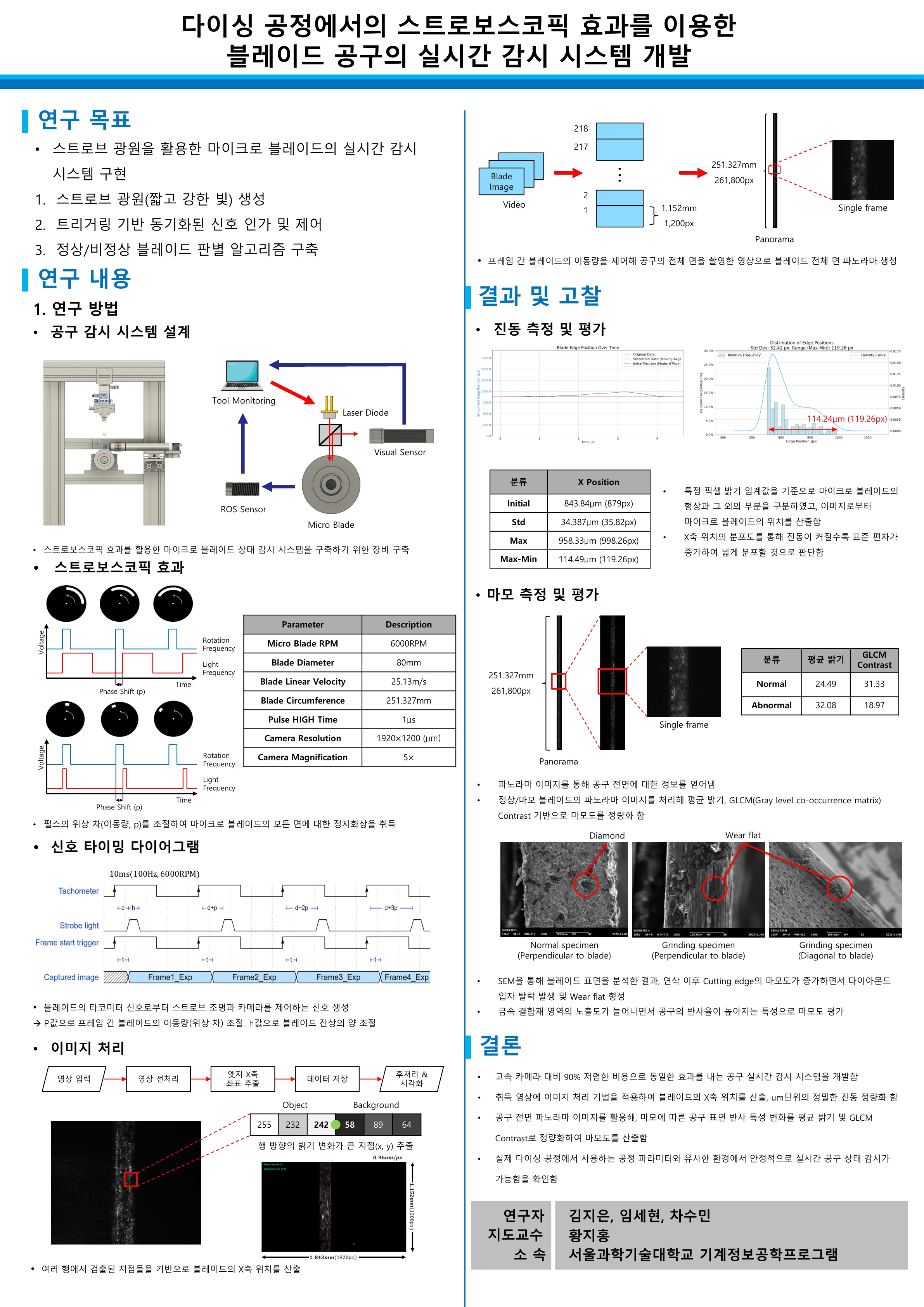
Development of a Real Time Dicing Blade Monitoring System Using the Stroboscopic Effect

Vibration and wear of micro blades in wafer dicing generate chipping and cracks, degrading yield and electrical reliability. Detecting these defects during operation requires real-time observation of rapidly rotating blades, yet conventional methods are limited in resolution, cost, and installation constraints. To overcome these limitations, this study applies a stroboscopic approach that provides high temporal resolution at significantly lower cost than high-speed cameras. The proposed system enables direct observation of the full circumference of the blade during rotation and allows real-time quantitative analysis of blade vibration and wear.


A Method for Saving the Energy Expensed during Idling of CNC Machine Tools

This study aims to promote energy conservation and sustainable industrial development from an Environmental, Social, and Governance (ESG) perspective, focusing specifically on improving the energy efficiency of machining centers. The machining centers which are integral in high-precision manufacturing and equipped with CNC and ATC systems, consume substantial energy, particularly during idling. In this regard, this study proposes strategies to reduce energy wastage during idling while maintaining processing accuracy. This is enabled by acquiring the temperature and strain data and correlating these data with the processing accuracy data which are obtained using a touch probe sensor. 


2023 Capstone Design


Control of Wire Electro Discharge Grinding using Fuzzy Logic

The demand for micro-precision tools is increasing due to the development of micro-scale tech industries. To enhance micro-precision, Wire Electro Discharge Grinding (WEDG), a hybrid process capable of on-machine fabrication of micro-tools and machining, has been devised as a method for micro-machining. In the WEDG system, the tool should be fabricated with uniform spark discharge energy, which is generated by controlling the proper distance between the tool and wire for precision. To properly control the distance, uncertain future conditions when discharge energy occurs between the tool and wire should be predicted statistically. In this regard, Fuzzy Logic, which defines uncertain conditions based on designated rules, was devised as a control method. As a result, it demonstrated better conditions for discharge voltage and processing time compared to other conventional control methods 

A Method for Saving the Energy Expensed during Idling of CNC Machine Tools

This study aims to promote energy conservation and sustainable industrial development from an Environmental, Social, and Governance (ESG) perspective, focusing specifically on improving the energy efficiency of machining centers. The machining centers which are integral in high-precision manufacturing and equipped with CNC and ATC systems, consume substantial energy, particularly during idling. In this regard, this study proposes strategies to reduce energy wastage during idling while maintaining processing accuracy. This is enabled by acquiring the temperature and strain data and correlating these data with the processing accuracy data which are obtained using a touch probe sensor.